Sunday, February 28, 2010


Alright y'all crazy kids, it's time for my newest post, and this one's a whopper. I've been rather busy reading-wise these past few weeks and have chalked up no less than five books! And five for me in a few weeks is quite an accomplishment, I'll tell you what. But rather than writing about them all in one massive post whose sizeness would dissuade anyone from reading it, I'll just break them up into separate chunks spread out over a few days. So let's get started with the first one, my obvious favorite...


Iron Council by China Mieville - This is the third book set in the world of Bas-Lag, which you should be familiar with if you read my first post about Mieville's books. And if you didn't read it, you're a very bad person who will never be happy and I don't want to know you.

The story takes place twenty years after the events of Perdido Street Station, in which the city of New Crobuzon is locked in a war with the mysterious land of Tesh. The war has dragged on for so long that the economy has slumped severely and as a result the people are becoming increasingly agitated. A young man by the name of Ori joins a rebellious faction that plans to assassinate the mayor, with high hopes that doing so will spur the people to open revolt.

A simple setup, but the story becomes much more layered and epic as it progresses. By the end I found myself very invested in the story and caring deeply what would happen next. Spoiler: It ends on a very sad note, and yet a glimmer of hope manages to shines through the grim conclusion, like a flashlight aimed into a pool of molasses.

One complaint I have with the fantasy genre (and you all know I have many complaints with the fantasy genre, because my name's Luke Kitchen) is that it seems, in order to maintain the reader's interest, the author will randomly introduce some character or plot point that has absolutely no meaning whatsoever but to provide a fun little distraction so no one realizes the story is running out of steam. Case in point, Tom Bombadil. What the hell was that guy, anyway? A metaphor for environmentalism? Some opium-induced nightmare of Tolkien's brought to life? Even as a kid I thought he was pointless, and that's saying something considering I read Goosebumps religiously.

Where was I? Lost my train of thought there... oh yeah. Needless, retarded plot points. Mieville never uses them. He rocks. I want to be the mother of his children.

Speaking of me having the schoolgirl hots for China Mieville, China Mieville is one of the greatest living writers in my opinion, and this book only reinforced that opinion. The characters are all well-rounded and thought out, never succumbing to the typical sci-fi/fantasy trope of becoming caricatures; the dialogue is actually good, another rarity for fantasy; the battles (and there are many) are suitably epic and marvelously detailed; and the imagination on display is quite wonderful - there's all sorts of magic and spellcasters and kooky creatures and high-flying machines and robots and bog monsters and man-eating trees and so on. Just when you think there couldn't possibly be anything more amazing and fantastic than a giant made out of earth and dirt who rips a parasite-controlled superman in half, creatures made entirely of the flesh and muscles of horses pop up. And don't even get me started on the light golem.

Point is, if you're looking for an excellent, enthralling, and... energizing fantasy story, then look no further than any one of the books in the Bas-Lag trilogy. You'll be hooked like I am and never look back. Plus, look at this guy!

"I crap awesomeness." - China Mieville

If that's not the picture of sexiness, what is? And I don't mean that in a gay way, just in a hey-man-I-wanted-to-say-that-you're-looking-okay way.

Thursday, February 25, 2010

Creating Magic, and also there is an idea tucked down there somewhere


So it must be self-help-type-book week, because I just finished a book called Creating Magic: Ten Common Sense Leadership Strategies from a Life at Disney. It’s basically about how to be a better and more effective leader, written by the former CEO of DisneyWorld.

Okay, yeah, I am a Disney geek, so obviously I enjoyed this book immensely. The strategies themselves were helpful but, like sub-title implies, sort of common sense, and can basically be boiled down to: “Don’t be a d-bag.”

The thing I REALLY liked about the book was all the stories Lee shared from DisneyWorld. There were seriously about three little anecdotes every two pages, and they just made my heart melt.

Like one time, a little boy lost his tooth at the Magic Kingdom and it fell down the drain. He was upset because it meant that the tooth fairy wouldn’t be visiting him, and a Cast Member noticed this. She called maintenance and they took the drain off, but they still couldn’t find the tooth. So the maintenance team made a fake tooth, wrapped it up beautifully, and had the family meet them later that day so they could present it to them, with a note that said Tinker Bell had found the tooth. WHAT. THAT IS SO MAGICAL IT MAKES ME WANT TO CRY.

Be cynical if you like, but Creating Magic was totally worth the read.

Also, I had an idea: what if we started utilizing the “tags” feature that Blogger offers? Just a thought. We could tag our posts with the genre of the book we are reviewing, like “fantasy” or “self-help” or “graphic novel,” et cetera et cetera. Eh eh?

Wednesday, February 24, 2010

As a Man Thinketh by James Allen


"Men are anxious to improve their circumstances, but are unwilling to improve themselves; they therefore remain bound."

I went through an experience this week that would have torn me to little pathetic pieces if it had happened even a week ago. Luckily, I was reading this book, and it has helped me tremendously to move forward and be the master of my thoughts instead of letting my thoughts destroy me.

This book figuratively and perhaps literally (I'll have to check) blew my mind. So much so that I read it twice. That is how good this book is. It will take you an hour, maybe an hour and half to read, but it will take you days, weeks, and possibly years to fully comprehend what James Allen is actually saying. Except it really is straight forward. I can't explain, just read it!

Every sentence of this book is quotable, but I will give you a few of my favorites

"The soul attracts that which it secretly harbors, that which it loves, and also that which it fears. It reaches the height of its cherished aspirations. It falls to the level of its unchastened desires - and circumstances are the means by which the soul receives its own."

"Cherish your visions; cherish your ideals; cherish the music that stirs in your heart, the beauty that forms in your mind, the loveliness that drapes your purest thoughts, for out of them will grow delightful conditions, all heavenly environment; of these if you but remain true to them, your world will at last be built."

"The world is your kaleidoscope, and the varying combinations of colours, which at every succeeding moment it presents to you are the exquisitely adjusted pictures of your ever-moving thoughts. So you will be, what you "will" to be. Let failure find its false content, In that poor word "environment,"But spirit scorns it and is free."

Monday, February 22, 2010

Never read a book about a crazy when yourself is slipping from sane.

But if you do. . . . . Then you should always ask yourself, "Where these 'I'm going crazy' feelings showing themselves before I started reading this book, or after I had begun?"

God Bless You Mr. Rosewater is a wonderful tale about a wonderful person Eliot Rosewater. Eliot is the inheritor of a grand fortune, or more specifically he's made President of the Rosewater Foundation. Which was created to keep the family money in the family and out of the tax collector's hands. The sum is equivilent to $10,000 a day including Sundays. Eliot is free to do with this money as he wishes. The only way to get this money away from Eliot is to have him proven insane. Many, including his father, consider Eliot insane partly because he sets up his so-called Rosewater Foundation. The foundation is located in a town in Indiana that has been abandoned by all but the lowest members of society. Eliot listens to their problems and prescribes his own specials remidies, most often money. For example if someone wants to commit suicide he'd ask them how much it would cost for them to keep on living for another week.

Now that you have a brief intro I'll do what one should always do with a Kurt Vonnegut book, shamelessly quote my favorite parts.

"Eliot hung up. The telephone rang immediately. 'This is the Rosewater foundation. How can we help you?' 'You might start by getting a haircut and anew suit,' said a man.

'What?'

'Eliot--'

'Yes--?'

'You don't even recognize my voice?'

'I--I'm sorry--I--'

'It's your Dad!' (This part edited for content)

'Gee, Father!' said Eliot, lyrical with love, surprise and pleasure. 'How nice to hear your voice.'

'You didn't even recognize it.'

'Sorry. You know--the calls just pour in.'

'they do, eh?'

'You know that.'

'I'm afraid I do.'

'Gee--how are you, anyway?'

'Fine!' said the Senator with brisk sarcasm. 'Couldn't be better!'

'I'm so glad to hear that.'

The Senator cursed.

'What's the matter, Father?'

'Don't talk to me as though I were some drunk! Some pimp! Some moronic washerwoman!'

'What did I say?'

'Your whole damn tone!'

'Sorry.'

'I can sense your getting ready to tell me to take an aspirin in a glass of wine. Don't talk down to me!' "

........Next Page........

"'Eliot--'

'Sir--?'

'I want you to take a good look at yourself.'

Dutifully, Eliot looked himself over as best he could without a mirror. 'I'm looking.'

'Now ask yourself, "Is this a dream? How did I ever get into such a disreputable condition?"'

Again dutifully, and without a trace of whimsicality, Elio said to himself out loud, "Is this a dream? How did I ever get into such a disreputable condition?"'

. . . . . .

"FH" stood for "Fly Hunt." People often felt a desperate need to do something nice for Eliot. He would ask them to come at a specific time in order to rid his office of flies. During the fly season, this was a Augean task, for Eliot had no screens on his windows, and his office, moreover, was connected directly to the foul kitchen of the lunchroom below by means of a greasy hot-air register in the floor.
So the fly hunts were actually rituals, and were ritualized to such an extent that conventional flyswatter were not used, and men and women hunted flies in very different ways. The men used rubber bands, and the women used tumblers of lukewarm water and soapsuds."
So as you can see God Bless You Mr. Rosewater is a zainy satire of fun absudities!

Friday, February 19, 2010

bird by bird.

I just finished a book I've been meaning to read since my English 2010 class, sophomore year of college. It's called Bird by Bird, by Anne Lamott. If you can't read the subtitle over there it says, Some Instructions on Writing and Life.

I LOVED this book. Even though it is directed towards aspiring writers, which I'm not, it is applicable to many forms of art and creativity, and yeah, life in general. Many things she said I want to apply to the way I approach photography and anything that I endeavor to create in my life.

Anne Lamott is an excellent writer herself, with the ability to create analogies and comparisons that caused me to literally to laugh aloud while reading it at work, as well as provide profound, thought provoking statements on life's truths, learned only through going through the arduous and probably painful experience of creating something from your soul. (Did I go too far with that sentence? Are you rolling your eyes at me?)

Here are a few of my favorite quotations (and I think you people will at least like the first one):

"...for some of us, books are as important as almost anything else on earth. What a miracle it is that out of these small, flat, rigid squares of paper unfolds world after world after world, worlds that sing to you, comfort and quiet or excite you. Books help us understnad who we are and how we are to behave. They show us what community and friendship mean; they show us how to live and die. They are full of all the things that you don't get in real life--wonderful, lyrical language, for instance, right off the bat. And quality of attention: we may notice amazing details during the course of a day but we rarely let ourselves stop and really pay attention. An author makes you notice, makes you pay attention, and this is a great gift."

"It helps to resign as the controller of your fate. All that energy we expend to keep things running right is not what's keeping things running right. We're bugs struggling in the river, brightly visible to the trout below. With that fact in mind, people like me make up all these rules to giveus the illusion that we are in charge. I need to say to myself, they're not needed, hon. Just take in the buggy pleasures. Be kind to the others, grab the fleck of riverweed, notice how beautifully your bug legs scull." (Oh... I love that.)

"Writing takes a combination of sophistication and innocence; it takes conscience, our belief that something is beautiful because it's right. To be great, art has to point somewhere."

"'So why does our writing matter, again?' they ask. Because of the spirit, I say. Because of the heart. Writing and reading decrease our sense of isolation. They deepen and widen and expand our sense of life: they feed the soul. When writers make us shake our heads with the exactness of their prose and their truths, and even make us laugh about ourselves or life, our buoyancy is restored. We are given a shot at dancing with, or at least clapping along with, the absurdity of life, instead of being squashed by it over and over again. It's like singing on a boat during a terrible storm at sea. You can't stop the raging storm, but singing can change the hearts and spirits of the people who are together on that ship."

Thursday, February 18, 2010

The DaVinci Code. I would take the DaVinci Code, so I could burn the DaVinci Code.

(its an office quote)


My three?


1) The Standard Works (Its lame that it has to count as one of our choices but whatever.)


2) C.S. Lewis Signature Classics with As a Man Thinketh glued into the front. (AJ did it!).


3) The Complete Works of William Shakespeare. (He pretty much wrote every plot line that exists thus far so I have a feeling I wouldn't be missing anything else.)


Sorry no pictures. I'm too lazy :)

Wednesday, February 17, 2010

Ken's exact post but by me. How unimaginative. . .


So this morning I wanted to answer the 3 books question but now I'm glad I didn't so that Ken could look like the original one. I'm always obsessing over orignality so this will be a good exercise in self-control.


Natural 1st: The Scrips, however, even though this is a trend being established I feel I have a unique take. My reasons are governed by the situation. A desert island forever, nothing could keep you occupied longer than the LDS standard works. My main reason, aside from spiritual enlightenment and the other things mentioned of which I agree, is that within the "quad" are the 4 standard works but also the Bible Dictionary and the Topical Guide. The studying possibilities these study aides offer is indespensable for any extended stay in a quiet reflective atmosphere.


The obvious 2nd, and as you'll notice I ripped off Ken's pictures as well, no sense trying to hide the obvious similarities between our choices. In preparing for my desert island adventure I would go out and buy the edition of the Lord of the Rings that comes in one solid volume. Yes, Ken you need not even try and persuade, Jet Warnick had this version, which is how Tolkin envisioned it with the entire work in one solid volume. The reason it was split into 3 is because of WWII, money was scarce and no one would have been able to afford the cost it would require to bind a book that large, they couldn't afford to make it, besides if they had few could have afforded to buy it. Since I have assumed that I have a bit of time to prepare I would take the Silmarillion and glue it to my solid version of Lord of the Rings. My reason for this and taking the Lord of the Rings in the first place is depth. I'm on an island forever, I need the appendicies to keep me busy. And it was my experience that the appendix in The Lord of the Rings is what made me enjoy the Silmarillion because the appendix eludes to the stories that are given more time in the Silmarillion. You need both and glue can make it happen. And if anyone wishes to challenge my glue idea then I'll just counter with, "I have prep time, I'll just take them and have them rebound as one, so suck it" But I think a rule should be established that you can only glue books together if they are linked like these books.


Again like Ken the 3rd is the most difficult. This book How to Make Whips, is my snap decision. My ok you on the floating Library of Congress about to be marooned you can grab three books. I would take this because Ken said there are animals on the island, hopefully some of them are Kangaroos so let's go to town and make some whips. As a snap decision I'll still be considering another choice. But a how to book seems like a great choice because you can use it to be productive and keep yourself occupied. And there are a lot of braiding patterns in this book that I'd never attempt unless I was stranded on an island with nothing but time.


Katniss' twisty 2nd Adventure! Mixed with a minor, unqualified treatise on issues facing sequels.


Here we rejoin our friend Katniss Everdeen as she's thrown into new adventures. I'm trying to write about this book without giving too much away. I'll start with my first impressions. At first I didn't like it as much as the Hunger Games. Though I think sequels sometimes struggle because they feel the same as the 1st book. And for me this is sometimes a good thing and sometimes bad. In this case it was slighty below the negative line. And as often happened to Harry Potter, the main character gets whiny, and when that happens I start to loose sympathy. Also one point of a sequel is to further hash upon issues established but not resolved in the 1st book. My Catching Fire/Hunger Games, reference here is Katniss' love triangle between the guy she at first had to love in the arena and now doesn't know, and the guy she had all along but didn't know he loved and now doesn't know. Really I didn't care about that aspect of the book this time around. The reasons for this and could transend to other sequals, especially in the teen section, is that in the 1st book Katniss discovers love or at least the pubesent signs of it. This is sweet and endearing. In the 2nd book it turns into teen drama, which is blah, blah, blah, grow up no one cares stuff. Also and I think the biggest challenge facing a sequel is a sibling of "This book feels the same as the 1st" and that is it not feeling fresh. Think about it, this blog exists because there is nothing in the world like diving into a new book, by an author you've never read. It's crisp and fresh like a new piece of celery. Books rock because of their variety, no two books are the same because they are written by people and no two people are the same. Anyway Catching Fire felt a little stale.
Now for the twisties. Despite all these pedantries the book was a smashing success. What got me was how the author created a feeling of predictablity but still managed to twist on you. Explanation: I felt like the book was predicable, like I knew what was going to happen but there were still big surprises along the way that threw me off the scent. Also Catching Fire shows its age group, it's written for a younger audience and in this book it shows. The Hunger Games is thrilling for any age, but Catching Fire gets a little more teeny. What I mean by teeny here is that it's the 2nd book, Collins is no longer laying out the plot she's having to turn and juggle it, which is a challenge to be sure. To wrap up my tangled mess of an entry, I'll sum the great feeling of suppossed predictability created in this book. It starts out familiar with the characters having to deal with minor sticky situations, then a twist sends them into a bind which you can't figure how they'll get out of, then it all blows up. Where the book shows it maturity level is that all along the way the signs are given which a more experienced reader picks up on and then in the moment of trial for the character you know they'll realize what you know and thereby what they'll do. Translation: At point A in the book you learn the solution to a problem at future point B, when point B arrives you know the next step, the twist comes because you don't know the step after next. Example you learn how to escape from handcuffs, so when you find yourself in handcuffs you escape, now you've escaped, now what? And this is what made the book interesting, the hints watered down the most tense moments of the book, but I liked it because I didn't know what the next step was.
Overall not as good as the 1st, a little stale. I recommend the Hunger Games as a must read, but you can leave Katniss at the end of the Hunger Games, and find yourself perhaps not completely satisfied but not at a loss for nightly sleep. Honestly it's a 2nd book of 3. If you were to read the Hunger Games and still required absolute resolution then I'd say skip Catching Fire, just have me sum it up for you in 3 sentances and go straight to the 3rd when it comes out. Last word: a worthwhile yet unnecessary read.
An apology for a close, I'm sorry for the length of this entry. It's 9:00 and I have nothing to do from now untill class at 12:30, but let me make it up to you. I found a new word, new to me. Dystopia: an anti-utopia. Often a futuristic totalitarian government of control and violence. I'm glad to know this word because I love these types of books.

Tuesday, February 16, 2010

My Three


Well, I must say that this question (which is the most important question anyone will ever have to answer in their life) has caused me a considerable amount of angst in its contemplation. I'm still not entirely sure on my number choice, but here is the result of my thinking and pondering:

Obviously if I was going to be stuck on some desert island where survival was not an extremely precarious affair and I could afford a single luxury of reading material, I would want the Scriptures. It's not just that they're essential to conversion and salvation (although a knowledge of those topics and Spirit-prompted reminders of their importance) that I would take them with me, but also because I love the presentation of the various stories, parables, and platitudes. It's an emotional journey reading them as well as an intellectual exercise. You think about thinks that you should think about a lot more when you read the Scriptures, and if I had only one book to take with me for a
permanent exile, I'd want the book who's study would insure both spiritual growth and intellectual development.

And now let's get down to the superfluous luxuries. While I doubt I can convince everyone to allow me to escape with the complete works of J.R.R. Tolkien as a single book candidate for taking with me to some exotic destination (we all know that the Hobbit cannot really be considered an essential portion of the Lord of the Rings, just like we really can't consider the Silmarillion an essential volume to that wonderful series [not because of a destitution of quality, but a more comprehensive subject matter]), I can make the undeniable case that you can't deny me the three volumes considered as a whole the Lord of the Rings, which J.R.R. Tolkien did intend to be published as a single book. So there. I get to spend decades specializing in Christian theology and then reading an allegory of Christian theology.

....
....
....
....

OK! I ADMIT IT! I CAN'T COME UP WITH A THIRD BOOK THAT I'M CONTENT TO READ FOR THE REMAINDER OF ETERNITY IN ADDITION TO THESE WONDERFUL VOLUMES!

this is odd. i've spent a lot of time thinking about what i would want with me, and i can't come up with anything. i want either the preeminent philosopher's tract, political-economical piece, or public policy/political volume. i'll post my thinking on the third when it becomes apparent.

Saturday, February 13, 2010

The Big Three

I knew this question was going to come up sooner or later.

Luckily, I am well-prepared to handle it, because it is one that Ken and I have discussed several times over, giving me an immediate advantage over all of you lay-people (aka LUKE). Suckas!

1. The Scriptures

Okay well, here you go, everyone can listen to me sound like a little nerd, but I think it would be a spectacular opportunity to be able to study the scriptures in complete solitude for years, with no outside (worldly) influence and just the peace of your own thoughts. Do I smell AWESOME, yes yes I think I do.

2. Jesus the Christ by James E. Talmage

You are probably now thinking, “Okay, now Kelsi is just trying to shove her self-righteousness up in my grill,” which is NOT TRUE. I actually have not yet read Jesus the Christ (but I bought my very own copy today and I am pretty fired up to start reading). But I hear it is a massive undertaking, and I think that being alone on a desert island would be the perfect opportunity to tackle such a challenge.

3. Peter Pan by J.M. Barrie

So it was either this or Mere Christianity, but even I know when I’m pushing a line. Peter Pan is easily my very favorite work of fiction—it is one of those that I am able and willing to read over and over again without tiring of it. Don’t ask me how, I think it’s a genetic anomaly. (My very favorite part is when Peter says, "To die will be an awfully big adventure." Swoon!)


End note: I hope everyone admires my impressive use of not one but THREE pictures on opposite sides of the text, because it has been a literal beast to format. But I persevere, for the good of the nation and for the good of the blog. And I will be the first to admit that it still looks a little skewumpus, but I do promise that I tried my best. Blogger's formatting is a bunch of jibba-jabba, if you ask me.

Friday, February 12, 2010

the most important question anyone will ever have to answer. ever.

so here it is. the most important question anyone will ever have to answer. ever.

if you were stuck on an island abundantly supplied with food, water, and game (thus to insure a moderately positive chance of long-term survival) and were allowed to take only THREE books with you to read for the rest of your life, which would you pick, and why?

some framing for this paradigm: the scriptures all count as ONE book, so you can get away with that, and because i'm a nerd, you also can take scripture markers and pens. Also you may have several journals of personal choice to record notes in, so they don't have to count as books.

so there you go. we haven't been posting in a while. i know this isn't really a post but it's book related and it is sure to inspire us to think critically about the most important books in our lives. my post will be following shortly.

Wednesday, February 10, 2010

The Far Side of the World


Well, considering that I have been so long without a post, I figured I might as well begin the process of re-entry with another wonderful book by Patrick O'Brian. The Far Side of the World is the story of Jack Aubrey and Stephen Maturin upon which the movie is based. The movie is really a loose conglomeration of the first ten books in the series based primarily on the story setting of the Far Side of the World. It is a tense and wonderful book which involves several strandings of primary characters (oh my!) and even a shipwreck (no!). As always I recommend the book, Patrick captures the essence of his drive with minute precision and really draws you into the feelings of his characters. So, read the books!

8.5 / 10

Thursday, February 4, 2010

Yippy Skippy!

"My ears are too beeg for my head. My head ees too beeg for my body. I am not a Siamese cat....I AM A CHIHUAHUA!
Skippyjon Jones is a loveable Siamese kitty that is under the delusion that he is a chihuahua. It is this delusion that leads him to experience many wonderful, though imaginary, adventures!


"My name is Skippito Friskito (clap-clap)

I fear not a single bandito (clap-clap)

My manners are mellow

I'm sweet like the jell-o

I get the job done, yes indeed-o (clap-clap)"
-Skippyjon Jones

I know what you're thinking. "Kelsha, what have you done, we post about real books on this blog." Well this book is the only thing I have managed to make it through lately.

Also, it is ADORABLE. If you have two minutes spare time I say its worth it to pick up a Skippyjon Jones book, because they rock!

Sunday, January 31, 2010

[Insert Clever Title Here]

(I hate writing titles on these things. Hate hate hate.)

I have approximately 29 more minutes as an 18-year-old, and what better way to spend it than writing a blog post, revealing these two things:

-Unfortunately, I didn’t make my goal of reading 19 additional books before I turned 19. I came up short by four. Darn.

-However, my last read was worth about ten books, so actually I read 25 books before I turned 19, so there you go. I'm not a failure! I can't be a failure!

This latter book is a short, 95-page burst of awesome called Made for Heaven by C.S. Lewis. My lovely roommate Betsy lent it to me, and I devoured it in about a half an hour. BECAUSE IT ROCKS.

It basically talks about man’s quest for heaven and why the active pursuit of attaining eternal paradise shouldn’t be viewed as opportunistic or mercenary. Lewis makes the point that we can never really understand heaven, no matter how close we think we get here on earth—and reading his views on the subject was a truly testimony-building experience.

I don’t know how I can really explain how beautiful this book is. It makes me excited for the afterlife, let me just tell you. C.S. Lewis would have made a great Mormon.

A quote:

“This signature on each soul may be a product of heredity and environment, but that only means that heredity and environment are among the instruments whereby God creates a soul. I am considering not how, but why, He makes each soul unique. If He had no use for all these differences, I do not see why He should have created more souls than one.”

Wednesday, January 27, 2010

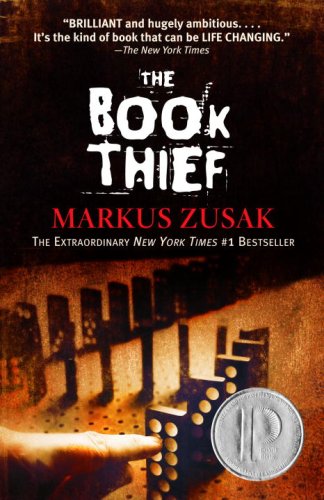
.the book thief.


Ohhhh I love this book.

The author is Marcus Zusak and it is the story of a little girl living in Germany during World War II. The reason I like this book is because it's not one of those really sad and disturbing holocaust books that tend to fill you with intense dread to turn each page because you just know the awful things that are coming. Somehow this author writes in an optimistic way, even about something like war. The story is charming and thoughtful and sweet, all while being realistic about a really terrible story.


I don't want to say much more, because I think you should just read it and enjoy his beautiful writing yourselves.

Tuesday, January 26, 2010

Harry's 1st is finished!


That was quick but I finished Harry Potter and the Sorcerer's Stone. I can't even guess when the last time I read it was but the only thing that jumped out at me this time is that J.K. Rowling is an anti-semite (if that's how you spell it) In her books nasty little goblins are the bankers. And as we all know in our world Jews are the bankers. She's compared Jews to nasty little goblins, how offensive!

Monday, January 25, 2010

"Creativity is a necessary sequel to being."


So listen. Sometimes, when I am having a particularly wretched day, or even if I have time to kill before work, I like to go to the library and just walk through the shelves. IT’S RELAXING, OKAY. And it was in this fashion that I picked up The Courage to Create, by Rollo May. (I checked out a book about the black market on the same trip.)

Basically, TCtC (as the fans call it) is a collection of essays about creativity. Creativity and the unconscious, creativity and the encounter, the limits of creativity, et cetera. Old Rollo had a clinical, almost scientific approach when talking about man and creation, and it was a little weird, I won’t lie. Also, at one point there was a very uncomfortable extended sexual metaphor about the artist and the encounter.

It was an abrupt departure for me, let me just tell everyone. I’m not really a non-fiction person, especially a non-fiction philosophy-type person, and with good reason—philosophy is usually boring for me.

I did enjoy Roly-Poly’s comments on the limits of creativity. His thesis is that limits are “unavoidable and valuable”, because humans naturally struggle against the things that limit them and therefore force themselves into progress. I absolutely agree with this—I find that my imagination thrives on conflict or struggle.

Anyway. It was interestink, but not sehr, sehr interestink. However, I have big hopes for Running Guns: The Global Black Market in Small Arms.

Kelsen

Treason's Harbor

oh. my. goodness. it is nearly one in the morning and i absolutely can't sleep. patrick o'brian has literally shaken my spirits to their pre-mortal core with this incredible tale of betrayal, bravery, and wholesome combat. while i am absolutely loath to reveal the secrets or insights into the workings of the plots of these wonderful books, i must break my vow to describe the final FIFTEEN pages of what may have been the best and most intense ending of a book that i have yet read. our very own captain jack aubrey and his trusted crew have been subject to betrayal and vice from an unknown mole within the british admiralty who has leaked the secrets of the service to the dastardly french in an effort to destroy the british' hold upon the mediterranean. while the intelligence agent stephen maturin has been busily aworking the case, other events transpire to send the hms surprise to a trap set by the enemies of his majesty. in a gripping and heart-wrenching FIFTEEN pages of novel we see the surprise and the pollux led into a ferocious trap where through shear sailing superiority and ultimate temerity captain aubrey manages to escape after sending one of the french frigates to its bottoms on the bay of zambra, or treason's bay (which actually refers to a number of bays, but who's counting?). the book was incredible, if only for the ending!

9/10


Sunday, January 24, 2010

Rand has reduced me to this!


In an effort to sooth my ravaged and scarred mind, I went to my shelf this weekend and pulled my dusty copy of the first installment of Harry Potter. No mystery or strange sexual twists here just straight up non-shellant reading. With any luck I may recover, or at least learn a healing charm to patch my broken mind.

Friday, January 22, 2010

Finding the Target

The Military needs to quit kicking the can around and start kicking the terrorist in the can.

That's what i learned from this book by esteemed military historian Fred Kagan. He talks about how the US Military has changed since Vietnam in terms of technology and strategic thinking. He talked about the shifting perception of the nature and method of war in order to achieve its rational aim: policy and political change. For instance, Air Force strategists, including a smart fellow named Boyd, developed a series of theories focusing on assessing information faster than your opponents and attacking critical nodes of infrastructure and centers of balance. These centers of balance were not necessarily leadership, or large troop centers, or infrastructure points, although they could be. Rather the focus was on finding the target of your mission (or the war) and targeting the specific resources utilized by the enemy that prohibit the accomplishment of that mission. For example, in structuring war games against the USSR in the event of war in Europe, instead of destroying the tens of thousands of tanks that the USSR would launch against the NATO forces, the better approach was targeting the fuel sources and lines of supply that kept those tanks going. It's a lot harder to hit ten thousand separate tanks than it is to hit one hundred fuel depots and railroad junctures. It seems kind of obvious but Clauswitz (the ultimate authority on the conduct of war) had said in the early 19th century that the center of balance in any force was the most powerful army component in it. Therefore he said that the crucible of victory was obtained in engaging and destroying that force and thereby defeating the enemy's morale.
Kagan also talks about lots of other things, which are interesting, but I think his primary point was that the military needs to consider politics in its transformation and to be more geared towards attacking the problems of the day than designing some super-force for the 22nd century.

8.5/10

The Supreme Court

kenny says....
This little ditty was a wonderful book succinctly explaining the history of the Supreme Court and giving a little context to the decisions that have shaped its development as a political institution. Our beloved former Chief Justice William Rehnquist authored it and performed admirably in giving the Supreme Court a little more practical image rather than its austere and isolated aura normally ascribed to it. I enjoyed the book for what it was and it helped me appreciate the historical forces affecting the decisions reached by the Court.

7/10

Thursday, January 21, 2010

More fantasy (and racism)


Geez, I don't check the blog for a week or so and when I come back we have this crazy word cloud skerfuffle going on. Here's what I propose: instead of writing our own names in our post repeatedly, we do a Secret Santa thing where we draw someone's name from a hat and then write that person's name continuously in our posts. So for example, Ken would draw my name and then would have to type Luke over and over while writing about 'The Philosophical Manifesto: A Treatise Being Of Human Nature And The Conflict Therein', or whatever the hell political book he's reading. Also, Ken smells funny.

But hey, we all know about Ken's repugnant odor. That's not what this blog is for (I actually started a blog dedicated to Ken's musk, kensmellsquiteterribleandhesabadperson.org). This blog is for books! And boy howdy, do I got some doozies for you: the writings of Robert Howard!

First, allow me tell you about Robert Howard, if I may. Robert Howard (RH from here on) was a writer born in the early 1900's who wrote pulp stories for whatever publication would buy his stories. Like many pulp writers at the time, his work was overlooked by the mainstream at the time but he has since become one of the most influential writers of pop culture (or any culture, for that matter). How influential? For starters, he practically created the sword and sorcery genre. And, he's the creator Conan. If the only thing that comes to your mind when I say Conan is "O'Brien" or "that movie from the 80's where an oiled-up Schwarzenegger ran around in tight pants, impaling whoever he met", then shame on you! You must be one of those people who isn't a virgin and has friends if you don't know who Conan the Cimmerian is as a literary figure. But it's okay, I'll gladly fill you in.

RH wrote a series of fantasy stories starring Conan, a grizzled barbarian, set in an ancient world populated by a multitude of mighty kingdoms, bloodthirsty warriors, and inhuman monsters. The world is unnamed, but I'm assuming it's Earth thousands upon thousands of years before history began to be recorded - not that I've done extensive research into this. Conan seems to have no goals in mind other than to seek glory wherever it's to be found, and so he wanders across this vast world. And though the setting of every story is different - sailing across the sea, crossing a wasteland, battling across a frozen Tundra - Conan is a warrior, so every problem he faces he attempts to solve with decapitation and death, which normally produces great results. But swinging a sword's not all he can do: he also steals whatever treasure he can get his hands on, drinks more alcohol than an oppressed Soviet citizen, and plows every scantily-clad woman he comes across.

Now I'm sure you're thinking to yourself "Man, these Conan stories sound like immature works of escapist fantasy, obviously beloved simply because they speak to the carnal, childish desires in men. Also, Luke is an extremely sexy and awesome person.", and you'd be right on all counts. These stories are pulp, after all, and as such they're supposed to entertain first and worry about all that "deeper meaning" crap last. But like the best adventure stories, it has resonated for so long in spite (or maybe because) of its supposed immaturity simply because RH was very good at what he did. His stories are extremely entertaining and gripping, and they always introduce some new thing into the mix to keep things fresh, such as a new ghastly monster for Conan to hack down or a new promiscuous woman for Conan to plow. His writing is bursting with imagination and excitement on every page, or as Stephen King said: "In his best work, Howard's writing is so charge it nearly gives off sparks." And let's not forget that action is one of the hardest things to write, but when done well it can be extremely satisfying. And RH knows how to write a battle scene, believe you me. I can't do justice to the fight scenes, mostly because I'm drunk and lazy. But rest assured, they're good. They're like "slash slash stab" and "ah oh my gosh I just got stabbed" and "that's right sucker you just got punk'd with a sword through your heart". So anyway.

However, before you decide to read these rip-roaring tales of adventure, know this: they're extremely racist and extremely sexist. The women fall into two categories: either they're heartless viragos or meek, subservient does. There's no in-between. Of course, they have one thing in common: they all want to get plowed by Conan. And boy howdy, does he oblige them.

And regarding the racism...
Johnny Carson: Boy, those Conan stories sure are racist.
Studio audience: How racist are they?
Johnny Carson: They're so racist that if you have a Klu Klux Klan member in your family then these books would make the perfect stocking stuffer. Hi-yo!
But seriously, every human opponent Conan faces is ethnic in some way (described as either yellow, red, or Negro black) and the only heroes are those who are whites. And whenever Conan is hacking down a non-white enemy, RH seems to describe the butchery with a sadistic glee. He was a citizen of early 20th-century America, where lynching was a popular pastime, so I guess you need to keep that in mind when reading them. But unless you have a swastika tattoo on your chest and consider yourself part of the master race, it still gets a little uncomfortable in places.

Oh, and if you like the tales of Conan, then I recommend you check out Solomon Kane, another creation of RH. He's a Puritan who wanders the earth, righting wrongs and smiting demons. So basically a missionary version of Conan. He's a very influential fantasy figure, blah blah blah, racism and sexism.

I'm also reading 'A Confederacy Of Dunces' and enjoying it quite a lot. I might post about it once finished. But maybe I won't! What do you think about that, huh?!?! TELL ME!!!

Wednesday, January 20, 2010

The Ionian Mission

The Ionian Mission reminds me of the tempo of the movie Master & Commander. There is some initial action which is heartily disappointing, followed by a monotonous period of blockade and patrol which is heartily disappointing, which is followed by a terribly exciting ship action where our own Jack Aubrey leads a daring attack against dirty Turkish rebels in a twenty page climax of maneuver, bravado, and triumph. Needless to say I loved it. I love how Patrick O'Brian titillates with a long and uneventful section then instantly springs this gripping narrative on you that holds you wonderfully captive to his story-telling. It's beautiful.

I give the Ionian Mission

7.5 / 10

(I am now going to start rating books)

PAIN!!


Pain is what I'm in, literary pain. I was floating along in 20,000 Leagues Under the Sea and I got tired of page after page of descriptions of fish. Fish that Jueles(his name is French so spelling is irrelevent) is assuming live off the coast of India or in the Mediteranian. In this boredom I felt a tremendous pull to pick up the Fountainhead again. I jumped back in with vigor, tearing through page after page. I've read so much I'm becoming an even bigger jerk than usual! Feeling I can say or do whatever I want, since I'm a god unto myself according to the great defeneder of selfishness Ayn. Everything was going great, I even read this book on the train and felt so smug and superior as I did so (ooo look at me I'm an intelectual) I was into the characters and just waiting for Howard and Dominique to join in their inevitable romance. The characters were beginning to get interesting all was moving nicely. Untill Howard and Dominique got together, this is what I was waiting for but this moment is a turning point in the novel. It's at this point that things turn psycotic!!! I was understanding the characters and the never ending and none-too subtle metaphores, then romance entered. Or Ayn's masacistic (I'm not sure of the spelling here or if this is the right word at the right time(I was scared to google it(the word I'm looking for is where people get their jollies from pain(dominatetress type stuff))) (HA! I was right but it's spelled masochistic(I searched dictionary first, then my poorly spelled masochism(I did not want nasty things popping up on my computer, my purity in this matter is 2nd to my hatred of masochists whose deviant nature make whips ugly and cause people to snicker when I mention them, also pervy sites come up when you search for whips because of these people and this too irritates me)) Ayn's own apparent masochistic nature. Now the novel has become full of crazies!! Howard Roark is no longer admirable because he's involved in some twisted sexual relationship. Rand sets it up so that you'll think these two people will be a great match but no!! They hate each other!! Dominique is a loon whom Howard rapes and she likes it. She even admits that if he wasn't raping her she wouldn't be getting her jollies off it! Then it gets really crazy when she decides she must join the rest of the drone world and destroy Howard, but her motives are different, but of course every character in this book's motives are, as they each represent something (ugh I'm so tired and my brain hurts so much from this book that I can't go into anymore detail of it's obvious metaphores, I'm exhausted!!) Anyway every time she diverts a commision away from Howard and to his enemy Peter (she does this so that Howard suffers as much as possible because a building he would have designed is then designed in the worst and most sacreligious way (to Howard) possible by Peter Keating)) she goes and shags Howard. Because she gets off on destroying him and then being ravaged by him. Can I get a ????? HUH ?????? My feeling is that while writing the book Ayn got sidetracked from presenting her ideal man and has deviated into a tangent of her ideal sexual relationship. I'm sure I'm write because I just watched an interview of her on youtube, and for being all, "F the world I'm selfish and independent" she sure has possibly the most shify eyes I've ever seen. It's one thing to hate commies and socialist but come on now. Maybe she thought if she created a philosophy so far to the other side people would come to the middle. Honestly I don't know if I can do it anymore, I burned through almost 200 pages without too much trouble and then it turned crazy. I'm so tired and in so much PAIN! Yet even now I'm questioning myself, "Can I finish? Can I leave it alone? Or must I finish?" Am I becoming a masochist? Is the Ayn's goal? Did she write this book as a form of tourture, so people could tourture themselves by reading it? And I can't even imagine Atlas Shrugged. It's twice the size of the Fountainhead and writen several years later. I imagine that being twice as long and writen later when Ayn's twice as in love with herself, it would be twice the tourture per page and being twice as long would leave you with four times as much pain! Can't I just make a deal with this book and start cutting myself rather than reading it?

Saturday, January 16, 2010

We Have a Barter System


Am I too lazy to write separate reviews for every single book I read? Yes, I am. Hence, the Super-Post.

Feminism with Annoying People

First, I read A Doll’s House, a play by Henrik Ibsen. I appreciated the feminist themes set forth by the play, but I felt that the main character, Nora, was unlikeable—maybe intentionally so. But good news! I downloaded it for free-ninety-free onto my Kindle! And it was worth every penny.

Blasphemy? Maybe So

Written by Neil Gaiman and Terry Pratchett, Good Omens is hands-down one of my favorite books of the year. It’s a novel about the Apocalypse, saturated with British humor, in which an angel and a demon on earth both conspire to prevent the end of the world. And it is hilarious.

Being Mean to Foreign People

Kelsha and I both read Heart of Darkness, by Joseph Conrad, about the same time. We should talk about that. It was an interesting, dark story about an ivory trader who goes crazy in the Congo (more or less ish). Apocalypse Now, maybe the weirdest movie on AFI’s top 100 list, was based on this book.

The Game is Afoot!

Spurred on by Guy Ritchie and Robert Downey Jr.’s collective genius, I decided to read a Sherlock Holmes mystery: The Sign of the Four. It was a very enjoyable experience, mostly because I recognized a lot of the quotes and situations in the novel, as they were used in the movie, including, “My mind rebels at stagnation!” Did you know Sherlock Holmes was a coke addict?


I’m working my way through Middlemarch by George Eliot, which is 800 pages long. So give me some time.


Kelsi

an addendum

the word cloud thingy is only updated upon my express command. so every post you write isn't going to result in a rearrangement and revision of it. i will update it every week or so. therefore: quick this obnoxious business.

and, in a further, slightly more devastating note:

it doesn't recognize 2 letter words

sorry aj

I Vote No


THE WORD CLOUD IS TEARING US APART.

And when we fight, the terrorists win.

(I actually just made this post to see if I could get "terrorists" up there. A few other words I wouldn't mind seeing in the word cloud: explosion, robots, Hans, and safari.)

In other news, I actually have several books I have recently read that I will post about at a later date. So gird up your loins for that.

OK I'M SERIOUSLY

Now I'm really not happy and this isn't fair. I just looked at this stupid word cloud of hatred, and Kelsha used "sassin" once! Just once and it made it into said stupid word cloud and AJ didn't. AJ is not happy and will not speak in the 3rd person anymore!! I hope you're all very happy and proud of your mean, nasty and hatful selves. This is discrimination and I will not stand for it so close to Martin Luther King day! I'm calling the NAACP!!

AJ thinks this thing is rigged

AJ can't find AJ anywhere and is wondering if a word has to be more than the two letters that make up AJ's name. If this is the case them AJ is screwed from the beginning and AJ doesn't want to play anymore. AJ doesn't like games AJ can't win. Not that AJ must always win but if a game is initially set up to prevent AJ from winning then AJ doesn't want to play. And AJ refuses to use his slave name An dr ew. AJ would rather never see AJ in the wordy thing then to see An dr ew up there.
AJ out
P.S.
I edited spaces into my slave name to prevent its appearance in the cloud of hatred.

AJ

Let's not kidd ourselves, AJ doesn't kidd hisself. AJ just wants to see AJ up in that lovely word thingy. AJ doesn't see AJ up there at all but AJ feels that if he writes AJ enough times AJ will show up in the AJ-less word thingy. AJ usually doesn't condone speaking of AJ in the 3rd person but AJ feels that AJ must consider this an special circumstance. AJ really wants to see AJ up there really big like religion or clouds. AJ doesn't think anyone but AJ should try this, because AJ wants his name to be biggest.
AJ out

Thursday, January 14, 2010

Just to be clear.

kelsha, i deleted your repetion. it ruined the word cloud. only you could ruin a word cloud.

just sassin.

but really. never do that again.

On to the Review
I didn't just post to say Kelsha a million times. I also read Benjamin Button. Its messed up, but then again so is F. Scott Fitzgerald sometimes (The Great Gatsby to name my only reference point). Anyway, there you have it.

It was a quick read, and I was moderately entertained, so for those purposes it was great. I just don't have much else to say about it really.

-Kelsha

Wednesday, January 13, 2010

sign your name

hey fellow intellectuals. you might have noticed this beautiful word cloud at the top of our blog. it is a random assortment of the words most prevalent on our blog. so now everyone needs to sign there name at the bottom of their post so it can show up on our word cloud. much blessing.

kenny

Tuesday, January 12, 2010

The Protestant Ethic and the Spirit of Capitalism-Max Weber

I forgot to write out this long, but interesting, quote from John Wesley on the nature of the riches cycle.

"I fear, whenever riches have increased, the essence of religion has decreased in the same proportion. Therefore I do not see how it is possible, in the nature of things, for any revival of true religion to continue long. For religion must necessarily produce both industry and frugality, and these cannot but produce riches. But as riches increase, so will pride, anger, and love of the world in all its branches. How then is it possible that Methodism (or any religion), that is, a religion of the heart, though it flourishes now as a green bay tree, should continue in this state? For the Methodists in every place grow diligent and frugal; consequently they increase in goods. Hence they proportionately increase in pride, in anger, in the desires of the flesh, the desire of the eyes, and the pride of life. So although the form of religion remains, the spirit is swiftly vanishing away. Is there no way to prevent this--this continual decay of pure religion? We ought not to prevent people from being diligent and frugal; we must exhort all Christians to gain all they can, and to save all they can; that is, in effect, to grow rich."

Ah the prophet's dilemma....

The Protestant Ethic and the Spirit of Capitalism-Max Weber

Why are Protestant's such good businessmen and all Catholics and non-Occidentals doomed to sub-rate employment for the duration of their mortal experience? That is the question which Max Weber attempts to answer in this treatise on the business benefits of Protestant and Reformist asceticism, and his answer is that the doctrines of making your calling unto salvation made sure and the true disciples of Christ being made instruments of His will and blessed accordingly fashioned the Protestant believers into a collective body who strived to not only excel in their spiritual discipleship but also to prove their position of divine favor by working to fashion their surroundings in a pattern of progress.
Calvinism (the main offshoot of Protestantism after Lutheranism) emphasized the doctrine of predestination and the role of true disciples to show forth an example unto other believers and non-believers. Those who were truly saved and called to salvation were believed to be blessed with temporal substance as a demonstration of their having successfully curried the favor of their Maker. This drive of proving oneself a saved believer through the manifestation of monied fruits pervaded a good portion of Protestantism and made its devotees peculiarly positioned to justify and secure the tenets of liberal capitalism with its equal emphasis on callings to work and individual reward based on merit rather than tradition.

Sunday, January 10, 2010

democracy and the rule of law

Well, another day, another scholarly work crossed off on the list of papers to peruse. The latest conquest is <--this book here, Democracy and the Rule of Law, a series of papers written by men smarter than me about the constancy of the law and the relationship between the majority being able to do what they want (aka democracy) and their collective will being limited in the scope of its action so as to respect individual rights, social norms, etc. (aka the rule of law). So it talks about what happens in a society when judges are independent but not neutral and the effect that judicialization on politics has on society, the difference between a rule of law and a rule by law, and it also talks about the balances of democracy and the rule of law and how that is perpetuated or destabilized. I wanted to read it because I believe the constancy of the law is a must for any free and liberal society to exist, but this book highlighted that the rule of law was not always a benefit (think about a rule of bad law). So it opened my eyes a bit. I would recommend chapters of the book to those interested, but not the entire book. Let's face it, sometimes even to the dedicated these books can get pretty boring.

Some quotes,

"....laws indicate to citizens when to act against governments. By coordinating expectations they facilitate collective actions that impose sanctions on governments."

"....the constitution matters not because governments feel a duty to obey it. Rather, it servs as a focal device, enabling particular individuals to guess what others will consider as major transgressions and thus agree when to act."

"We are in the presence of the rule of law when the rules defining permitted and forbidden actions are not discretionary decisions of an individual, but rather take the form of laws that discipline every citizen, regardless of his or her power or status....the problem with the rule of law derives from the difficulties subjects have in making those who rule obey the law."

and my personal favorite

"This is the art of politics: to find some alternative that beats the current winner."

Saturday, January 9, 2010

a review of wicked, by mrs. kristin brown

YAY for me finally contributing here!

I just finished Wicked, by Gregory Maguire. It has taken me a loooong time to get through this dang book because I really just did not enjoy it. I have been meaning to read it since I saw the musical the first time, which I LOVE, and finally bought the book on Kenny's recommendation.

Now I am not the most critical reader and usually have good things to say about most books, but this was a hard one for me to see the good in. I won't harp on all the things that got to me, but I will delve into a few.

My biggest complaint is the development of the characters. When I read a novel, I love to love the characters and be able to root for the hero/heroine, which I couldn't do in this book. I really wanted to love Elphaba (who becomes the Wicked Witch of the West), but nothing ever happened to endear her to me. She is a passionate and strong woman, but goes about all her endeavors the wrong way with the wrong motives. The novel spans her entire life and never once did I find any reason worth rooting for her.

Even Glinda, who is a naturally more loveable character, didn't give me any reason to really like her. Her role just fizzled out halfway through the story and I was never left with any kind of closure on her character, even though she was one of the main characters.

Speaking of closure, there wasn't much closure of any kind on many of the characters and plotlines introduced (the traveling time clock, why she is green, why she can't touch water, the real role of Wizard).

The themes of the novel deal with the nature of evil and the power of forgiveness, and there are some good discussion topics there (I really found Elphaba's unfulfilled need for forgiveness from her lover's wife as it related to Dorothy's need for forgiveness from Elphaba for killing her sister interesting....)

But by the last fourth of the book, I felt there were unanswered questions and I was still wondering what the point of the whole thing was. I was hoping for a catharsis, a cleansing, healing moment for Elphaba or any of the characters at some point, but it never came.

Basically, aside from all the technicalities of what makes a good novel good (which I am by no means a literary expert on), I just didn't enjoy the book. I did make myself finish it, which can't be said of all books I don't like (ahem, the stupid FOUNTAINHEAD), but I won't read it again and I don't recommend it to anyone.

Seriously, just see the musical. The writers for the Broadway show did much more with the characters and plotlines of Gregory Maguire's idea than he could. :)


Tuesday, January 5, 2010

A prince is nothing beside a principle


"A soul for a piece of bread. Misery makes the offer; society accepts."


I just finished Les Miserables. It has always been my favorite story. It is now my favorite book.

"So long as there shall exist, by reason of law and custom, a social condemnation, which, in the face of civilisation, artificially creates hells on earth, and complicates a destiny that is divine, with human fatality; so long as the three problems of the age--the degradation of man by poverty, the ruin of woman by starvation, and the dwarfing of childhood by physical and spiritual night--are not yet solved; as long as, in certain regions, social asphyxia shall be possible; in other words, and from a yet more extended point of view, so long as ignorance and misery remain on earth, books like this cannot be useless." -Victor Hugo

The heartache and trial portrayed in this book is extensive and all-encompassing. Basically, Victor Hugo forces his reader to watch and take part in the suffering of people from every age group: young, old, man, women and worst of all child.

It was a genius way to show les miserables (the miserables). This books shows that in the end politics, money, and position in society can never replace the worth of a human being. Its cheesy, but I really feel like my level of compassion for others is increased signifigantly from reading this book.

As much as I loved all of the characters in this book I had two favorites, which I will focus on in this post, Gavroche and Jean Valjean.

Gavoroch is a child hero. The entire book he demonstrates innocence and goodness, though he has never been taught right from wrong by his terrible parents or environment.

The poor child is abandoned and forgotten in the streets of Paris early on and must look out for himself but still finds time to take in two newly abandoned children. He sacrifices everything without a second thought and with a joyful song.

At one point (after he has been on his own for quite awhile) he saves his fathers life. Someone tells his wretched father that it was his son that just saved him. The father walks off. He leaves when his son is sitting right there waiting for just a glance, an acknowledgement of his existence. To this sad situation Gavoroch just shrugs and continues on, singing--without the slightest sign of resentment or sorrow.

As for Jean Valjean he is just amazing. He suffers every injustice and feels every form of pain, but just keeps going anyway. I can't explain how awesome he is, and I won't try. Just know that I want to be like him if I grow up.

This book is so big I can't begin to describe how much I love it without making this even longer, so I will leave it at this. If you have a bunch of time on your hands don't miss this book. I think everyone should read it at least once in there life, but that is just me I suppose.

Sunday, January 3, 2010

Frodo, don't wear the ring.


Speaking of preconceived ideas about a novel, I just finished reading The Fellowship of the Ring—a book that is just a loaded gun of expectations. Throughout, I kept comparing it (consciously and un) to the movies and parodies I have seen, and even to modern-day fantasy books I have read.

It’s good literature. Complex but easy to read, inspiring sometimes, humorous at others. Gandalf’s “fall” (what else could I call it? Not death) was sad, Boromir’s betrayal(ish) was frustrating. Pippin is funny and I’m pretty sure Sam is gay.

I do plan on reading the rest of the trilogy, after February 1st. And, just so y’all know: I have to read ten more books if I plan on making my goal of nineteen before I turn nineteen. So pray for me.